Finding Your Foundation: A Guide to the World’s Most Popular House Styles
Finding the right home is about more than just four walls; it’s about matching a structure to your lifestyle and budget. From the snow-ready Swiss chalet to the space-efficient tiny home, we break down 11 essential house types to help you navigate the 2026 real estate market.
Finding Your Foundation: A Guide to the World’s Most Popular House Styles
A home is more than just a shelter from the wind, rain, and heat; it is a sanctuary tailored to your habitat. Choosing the right property requires exploring a diverse range of styles. Whether you are looking for a single-family residence or a multifamily complex, your final decision will ultimately depend on your budget, lifestyle preferences, and long-term needs.
In today's mobile world, housing needs shift frequently. Depending on regional conditions and personal circumstances, people choose between temporary dwellings, permanent estates, and everything in between. Here is a comprehensive look at 11 popular house types, their structures, and their unique styles.
1. The Chalet
Originally used as cabins for Swiss goat and sheep herders, the chalet has evolved into a beloved mountain cottage style. While they began as simple herders' huts in the Arpitan-speaking regions of Switzerland and France, they are now synonymous with luxury ski vacations.
Key Features: Steep roofs and wide, protruding eaves designed to shed heavy snowfall.
Best For: Vacationers and those living in high-altitude, snowy climates.
History: Their popularity peaked in the early 20th century in regions like Colorado and Ohio, eventually transforming from functional farm shelters into iconic Alpine lodges.
2. Cave Houses
Cave dwellings are among the oldest forms of human habitation. By utilizing natural structures, ancient societies created complex, beautifully designed underground cities.
The Santorini Style: In places like Santorini, Greece, homes are carved into volcanic rock. These are highly affordable, eco-friendly, and naturally insulated.
Cost: On average, a modernized cave home in a prime location like the Greek islands costs approximately $230,000.
3. Mansions
A mansion is generally defined as a grand residence spanning at least 12,500 square feet, though "luxury" is its true defining trait.
Amenities: These homes often feature specialized rooms like movie theaters, spas, and private libraries.
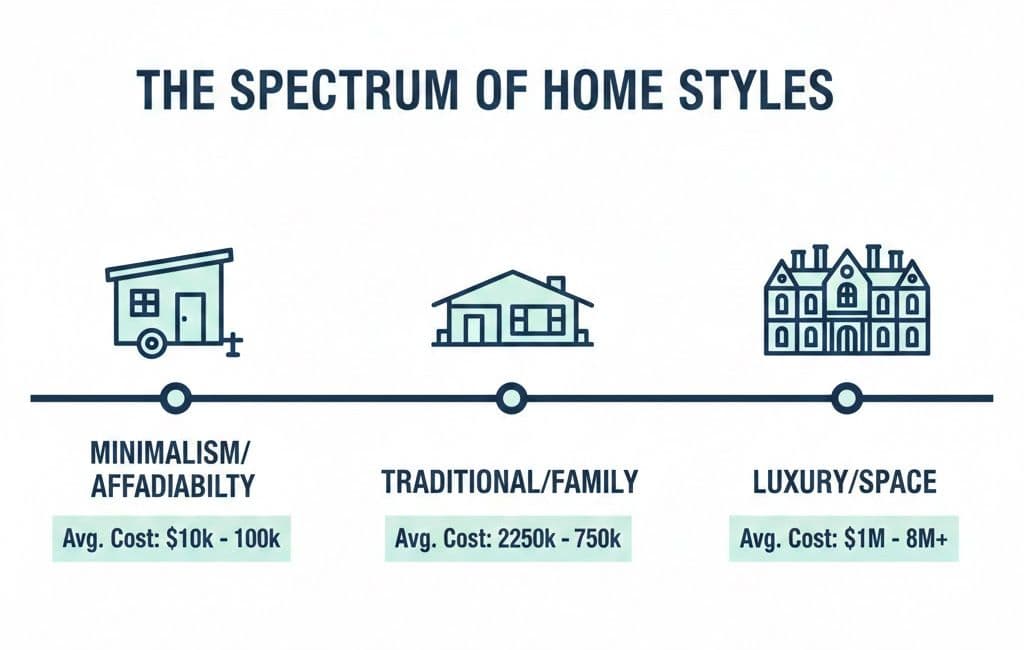
Cost: Prices typically range from $750,000 to over $8 million, depending on location and custom finishes.
4. Dome and Round Houses
Spherical or ellipsoidal in shape, dome houses are structural marvels. While the initial cost of a monolithic dome is comparable to a custom standard home (around $100,000), the long-term savings are significant.
Benefits: Exceptional energy efficiency and an open-concept interior that allows for limitless architectural creativity.
5. Cabins
Often confused with cottages, cabins are defined by their rustic, minimalist nature. While cottages can be found in urban areas, cabins are almost exclusively rural.
Construction: Traditional log cabins use stacked timber sealed with mortar or mud.
Cost: A basic one-bedroom cabin kit starts around $30,000, while larger, custom five-bedroom designs can reach several hundred thousand dollars.
6. Single-Family Homes
The most common residential structure, the single-family home offers maximum privacy and land ownership. These are ideal for families seeking a permanent "forever home" with a private yard and no shared walls.
7. Apartments
An apartment is a self-contained unit within a larger building. This is often the most accessible entry point into the housing market.
Cost: Depending on the unit size, mid-range apartments generally cost between $85 and $200 per square foot.
Benefits: Lower maintenance and access to shared amenities like gyms or pools.
8. Ranch-Style Houses
Popularized in the mid-20th century, ranch homes are single-story residences featuring open-concept floor plans and attached garages.
Key Features: Low-pitch rooflines, large windows, and easy access to outdoor patio spaces.
Materials: Typically built using brick, wood, or stucco.
9. Townhomes
A townhouse is a multi-story building that shares one or two walls with adjacent properties but features its own private entrance.
The Middle Ground: It offers the feel of a single-family home without the high cost of land.
Investment: Many townhomes are governed by Homeowners Associations (HOAs), which handle exterior maintenance and community safety.
10. Tiny Homes
The tiny home movement caters to those seeking a minimalist, eco-conscious, or mobile lifestyle. These homes range from 100 to 400 square feet.
Cost: You can build a DIY tiny home for as little as $10,000, or buy a high-end prefab model for $100,000.
Appeal: They are often seen as a solution to the modern housing affordability crisis.
11. Bungalows
Bungalows are typically small, single-story homes (sometimes with a second half-story in the roof) featuring wide verandas and dormer windows.
Aesthetics: They often use natural materials like cedar shingles and stone.
Cost: Construction averages between $181,000 and $552,000, largely dependent on the price of the land.
الكلمات الرئيسية
وسوم